ERP Connectors: Connecting Shop and Enterprise Resource Planning
Synchronize product data, stock & availability, prices and orders between ERP, marketplace and store
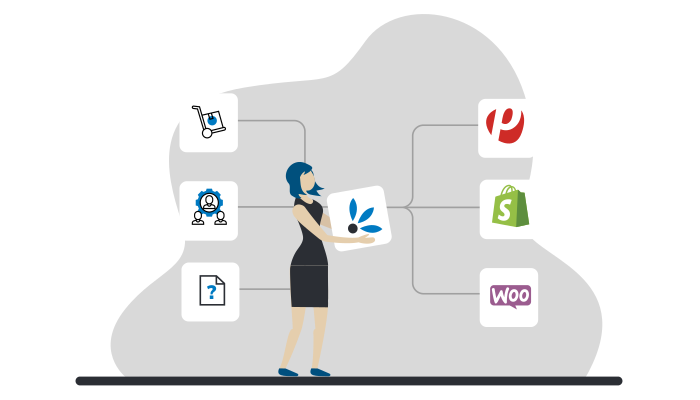
Stock & Prices always be up to date!
Especially in online retail, keeping data such as inventory and price up to date is enormously important, as it helps to avoid overselling. Especially in the multichannel environment, where a common inventory is shared between different sales channels such as store and marketplaces, it is important that it is always up-to-date.
Store operators with a large range of goods often obtain item and inventory data automatically from suppliers or from their own backend systems. This is usually done in the form of CSV files, which are provided via (S)FTP or HTTP(S) interface. The goal is to import these data into all involved systems and to keep them up-to-date.
With Synesty Studio you can automate import, export and data preparation.
This provides you with a flexible solution for individual automation and connection to various systems such as marketplaces, ERP, dropshopping providers, inventory management, product data management systems (PDM), product information management systemse (PIM) and order management systems (OMS).
Integration of suppliers, shop, market places or backend systems
A classic field of application for Synesty Studio are interfaces between Enterprise Resource Planning (ERP), suppliers and online stores as well as marketplace connections. The aim is always to import changes of the inventory managing system - usually the ERP system or a supplier - to the store or marketplace in a timely manner and to import orders back to the WaWi so that the goods can be packed and shipped.
Depending on the systems used, there are different approaches to how this can be done. Often the way via CSV/XML files and a (S)FTP server is used for data transfer. The WaWi provides article changes like price and availability changes as a file. With Synesty Studio this file is read in and prepared as required by the store or marketplace. But it is also possible to access the interfaces of the respective systems directly via API. The whole thing is possible without programming via ready-made modules.
The exchange is usually time-controlled (e.g. hourly or freely configurable), but can also be triggered by an external system via a URL. In Synesty Studio you can then follow each execution exactly and are immediately alerted to problems or errors via notification so that you can react.
This sounds like APIs, ETL and cronjobs - but without code and programming.
That's right - no code. However, the terms ETL and cronjobs are used more in a technical environment and are less familiar to many users. We therefore rarely use these terms.
ETL is the abbreviation for Extract Transform Load and refers to processes that involve the import and transformation of all kinds of data. Technically Synesty Studio takes the role of an ETL - Middleware, because Synesty Studio is always located between at least two systems and controls the data exchange and automation. Cronjobs are time-controlled processes. The term comes from the world of Unix operating systems and is well known among administrators and programmers.
However, Synesty focuses on the essential use cases that can be implemented with it. Therefore, we try to avoid technical details and terms, as they are often not relevant or confusing for users - in line with the No Code / Low Code approach. You create all processes in our graphical Flow editor with visual building blocks. We recommend basic knowledge of spreadsheet programs to get started. For complex IF-THEN logics we also offer scripting possibilities (low code). This gives you full flexibility to process any imaginable data format (XML, JSON, APIs etc.) and implement integrations.
E-Commerce integrations
Synesty Studio supports among others interfaces and connectors to:
- Amazon Seller Central (SP-API)
- Amazon Vendor Central
- Billbee
- plentymarkets
- Shopware
- magento
- veloconnect
- shopify
- WooCommerce
- repricing services
- various systems with file-based CSV/XML datafeeds via HTTP & (S)FTP, Dropbox, Google Drive, Microsoft OneDrive, CRM oder Ads
- See all of our Add-Ons and Integrations
Practical example
Read our practical examples and case studies how Synesty is used by companies to automate processes, e.g. to let e-commerce systems, PIM and ERP talk to each other.
Example - Integration with Shopify
 Das Video wird bei Klick von Youtube geladen und abgespielt. Dabei stellt Ihr Browser eine Verbindung zu den Youtube-Servern her. Es gelten die Datenschutzhinweise von Google / Youtube
Our whitepaper for Makers: No Code Integration & Automation
Related articles


Last updated July 21, 2023
Chat with us