Automate supplier connection
Avoid overselling through automatic inventory reconciliation, price updates, and automatic reordering.
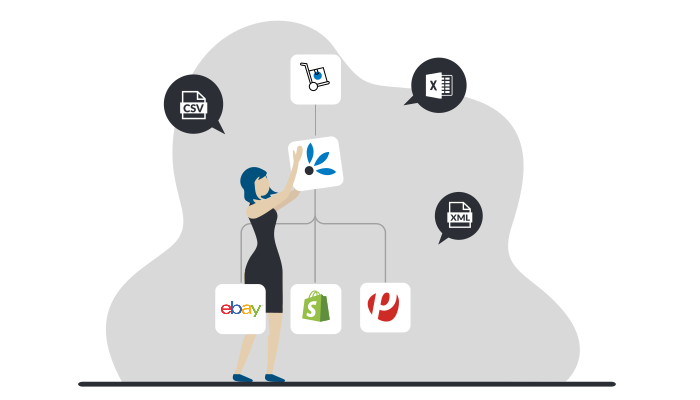
Supplier interfaces - everyone does it differently.
Successful supplier management is essential for an online business. Suppliers are the first point of contact when it comes to reorders, prices or new product launches. Often, supplier connections are about topics such as avoiding overselling through automatic inventory reconciliation and price updates, as well as automatic reordering.
However, communication between retailers and suppliers can be difficult, as there are many different and little standardized data formats and transmission paths for transferring product data and availability to retailers. But this is a prerequisite for automating supplier connections.
What are the most common problems?
- missing connection and automatic data import of product data or orders
- time-consuming manual reordering
- input of new product catalogs is complicated and time-consuming
- low data quality: e.g. incomplete product data (e.g. missing EAN, product description, ID etc.) or incorrect data (e.g. EAN - too short or missing check digit)
- time-consuming troubleshooting
- risk of overselling, because price fluctuations and stock changes on the part of the supplier cannot be imported automatically
- complicated calculations of sales prices or discount promotions have to be done manually
It becomes particularly confusing when several suppliers are involved in the procurement process. Retailers cannot automatically integrate the many suppliers into their systems and valuable time is lost due to tedious and manual entries. With Synesty Studio you can automate the whole information flow between you and your suppliers. The cloud solution is flexible and therefore applicable to any file format.

Your advantages with Synesty Studio
In contrast to rigid interface solutions, the Synesty Studio software can be flexibly adapted to your requirements. This allows the implementation of a large number of use cases, such as:
- Connection of suppliers and implementation of dropshipping scenarios
- merging of different data formats
- automated, momentary transmission of repeat orders (e.g. with an article stock of < 4)
- automated, momentary transmission of stock, availability, purchase price (EK), discount, notified delivery time, product description, pictures and other product properties
- import of tracking numbers
- checking and monitoring of data quality to detect incorrect or incomplete data
- automatic notification by e-mail when certain events occur (e.g. missing data from supplier)
- support of different transfer methods for synchronization of files via FTP, dropbox or Google Drive
- Calculation of sales price according to own formulas and rules (e.g. for discount promotions)
- repricing and market price analysis via BENY-Repricing, priceAPI, patagona and other service providers to optimize price offers on numerous marketplaces and price search engines
- Direct integration of back-end systems, such as merchandise management, financial accounting and warehousing
- supplier connection to different systems with already existing modules (e.g. plentyShop, Shopware, Shopify, plentymarkets, veloconnect, Tradebyte)
- Merging of different data sources (ETL), interfaces and services (CSV, XML, JSON, APIs, web services, (S)FTP, HTTP(S)
Example video - supplier connection using Shopify as an example
In this tutorial we will show you how to establish a successful supplier management for your online store with Synesty. It will be shown how to fetch a supplier file and how to read it in, how to recalculate the prices of the single articles of your supplier file, how to define a rule to filter out articles that have no stock and how to prepare the articles as your target system needs it.
 Das Video wird bei Klick von Youtube geladen und abgespielt. Dabei stellt Ihr Browser eine Verbindung zu den Youtube-Servern her. Es gelten die Datenschutzhinweise von Google / Youtube
Supplier connection models / sales models
E-commerce is characterized by a multitude of different sales strategies, as well as manufacturing and supplier models. However, Synesty Studio is able to connect suppliers to any business model due to its generic interface communication. This includes e.g. dropshipping, just-in-time reordering or the classic direct sales with own warehouse and pre-ordering at the supplier.
Dropshipping
The dropshipping model is completely different from classic online retailing and is currently experiencing a real hype in Germany. Unlike other models, the online retailer has none of the products it offers in stock itself. When he receives an order, he forwards it to the supplier or wholesaler. From here, the products are then shipped to the end customers. The end customer is unaware of this process, however, because in this model the online retailer is in contact with the end customer for all transactions and not the wholesaler, who merely sends the packages in neutral packaging. The wholesaler usually transmits the tracking number to the online retailer so that the latter can inform the end customer about the shipping status, e.g. by email.
Just-in-time production
In just-in-time production (JIT), only those quantities or numbers of items are produced or reordered from the supplier that are actually demanded and ordered by the end customers. This has the advantage that online retailers do not have to bear high storage costs, thus reducing lead times. However, this model can only work if the suppliers and retailers are optimally coordinated with each other, thus enabling short and problem-free delivery. However, the online retailer is still responsible for delivery to the end customer.
Our whitepaper for Makers: No Code Integration & Automation
Related articles

Last updated May 27, 2017
Chat with us